
The European Commission checks the progress of the PYRENEES4CLIMA project to adapt the Pyrenees to climate change
- The initiative, led by the OPCC, is developing 33 pilot cases that address different experiences of adaptation to climate change.
- Representatives from the European institution visited examples such as Biescas, to learn about the work being done to diversify mountain agriculture through aromatic plants; and Canfranc, where the protective role of the forest against landslides and avalanches is being reinforced.
- The field visit concludes a three-day meeting held in Jaca, where the development of the PYRENEES4CLIMA project was presented.
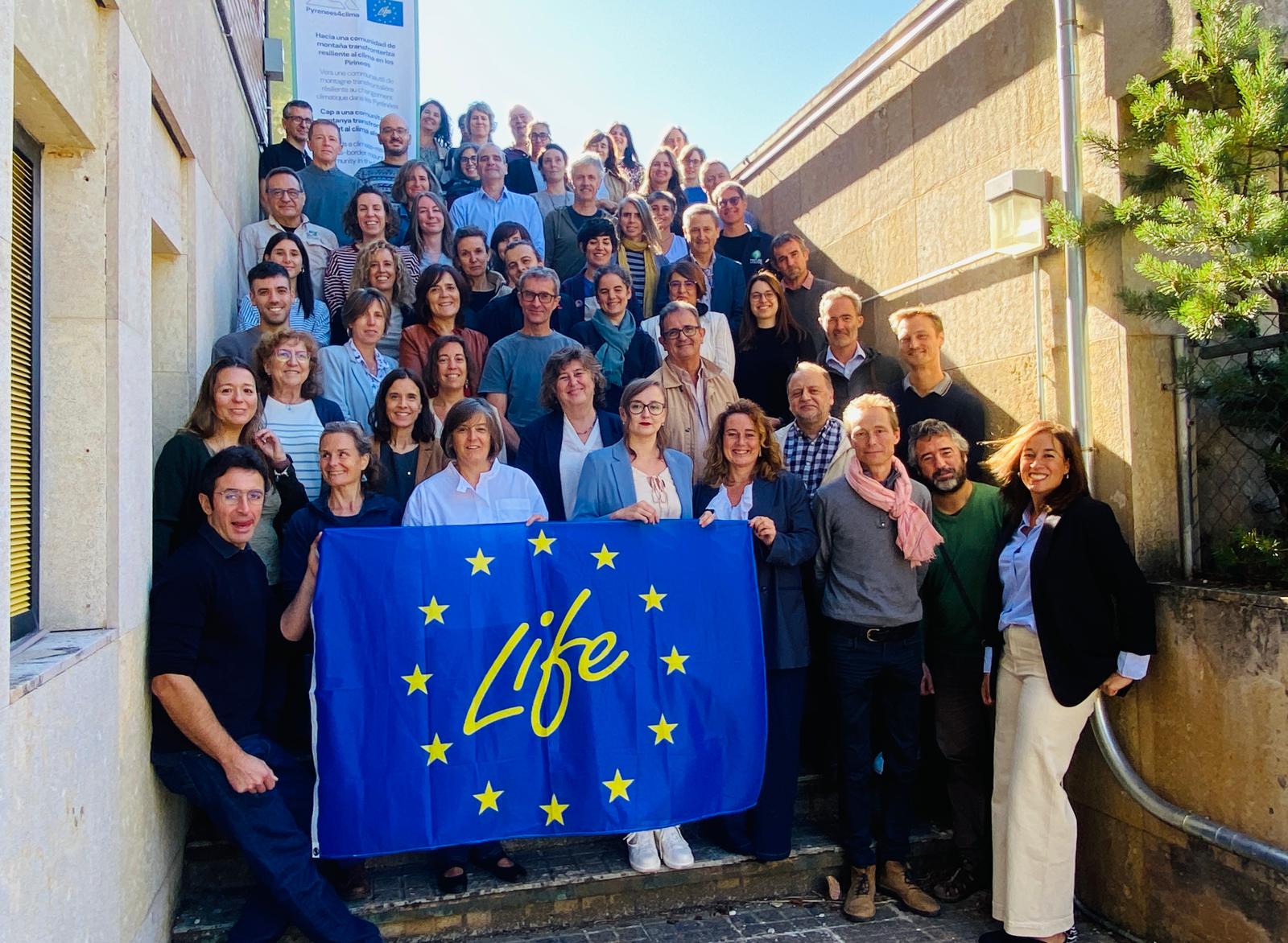
Jaca, October 2025. With the aim of assessing how the PYRENEES4CLIMA project's measures to make the region more resilient to the effects of climate change are influencing the territory and the people who live there, the European Commission visited five pilot projects being developed in the Aragonese and French Pyrenees. These examples are part of the 33 pilot cases promoted by PYRENEES4CLIMA. The field visits were the culmination of a three-day meeting in which the 46 entities that make up PYRENEES4CLIMA presented the progress of the actions carried out throughout 2025 to two European representatives, Pepa Diamantopoulos and Verónica Soporska.
‘We want to show on the ground and with concrete examples how we can tackle adaptation, consolidating all the knowledge and involving local actors to determine the most appropriate measures for each territory. These are examples that will help us to transfer and replicate more quickly,’ explains the coordinator of the Pyrenean Climate Change Observatory and the PYRENEES4CLIMA project, Eva García-Balaguer. The project, she adds, ‘is an unprecedented opportunity to adapt collaboratively and with a multidisciplinary vision, taking advantage of our resources in an increasingly common and pressing reality.’
The role of forests and the case of fruit trees
Field visits to Canfranc have demonstrated the importance of the protective role that forests can play against avalanches and landslides. This work, led by AECT-Pirineos-Pyrénées, is being carried out in parallel in Benasque and the Ossau Valley (Atlantic Pyrenees). Another point of interest was Biescas, where an innovative agricultural diversification project based on aromatic plants and fruit trees is being developed, led by the CITA (Aragon Centre for Agrifood Research and Technology). This initiative is also being carried out in Ara (Jaca) and Ligüerre (Aínsa).
The agenda included projects of great relevance for the sustainable management of natural resources, such as the local water pact promoted by AUDAP in the Nay Valley (Nouvelle-Aquitaine), aimed at promoting the shared and responsible use of this vital resource. In Hoz de Jaca, the European representatives learned about the land stewardship agreements led by SEO/BirdLife, which involve small Pyrenean municipalities in adapting to climate change and protecting sensitive ecosystems.
In addition to the fieldwork, on Wednesday and Thursday the European Commission representatives attended the formal ELMEN-CINEA follow-up meeting held in Jaca to discuss the status and progress of the PYRENEES4CLIMA project. During these working sessions, the 46 project partners reported on the steps taken to date. The conference was attended by Yann Hélary, Secretary General of the CTP (Pyrenees Working Community) and Olvido Moratinos, President of the Jacetania region. At the opening ceremony, Hélary highlighted ‘the extremely important value of the collaboration and cooperation carried out by PYRENEES4CLIMA, which helps us to continue advancing towards European objectives’.
20 million euros until 2031
The project, approved in June 2023 by the LIFE programme, has a budget of around 20 million euros and will run until April 2031. Its actions are aligned with the Pyrenean Climate Change Strategy (EPiCC), a pioneer in Europe for its cross-border approach and approved in November 2021 by the seven Pyrenean territories of Spain, France and Andorra. The EPiCC seeks to improve the resilience of the mountain region, protect its natural capital and ensure the well-being of its citizens, strengthening cooperation through knowledge transfer and innovation.
With PYRENEES4CLIMA, the Pyrenees are consolidating their position as a living laboratory for climate solutions at the service of Europe, demonstrating that cross-border cooperation is key to responding effectively to one of the greatest challenges of our time.



PYRENEAN CLIMATE CHANGE OBSERVATORY
Avenida Nuestra Señora de la Victoria, 8
22.700 - Jaca
Huesca - España
+34 974 36 31 00
info_opcc@ctp.org